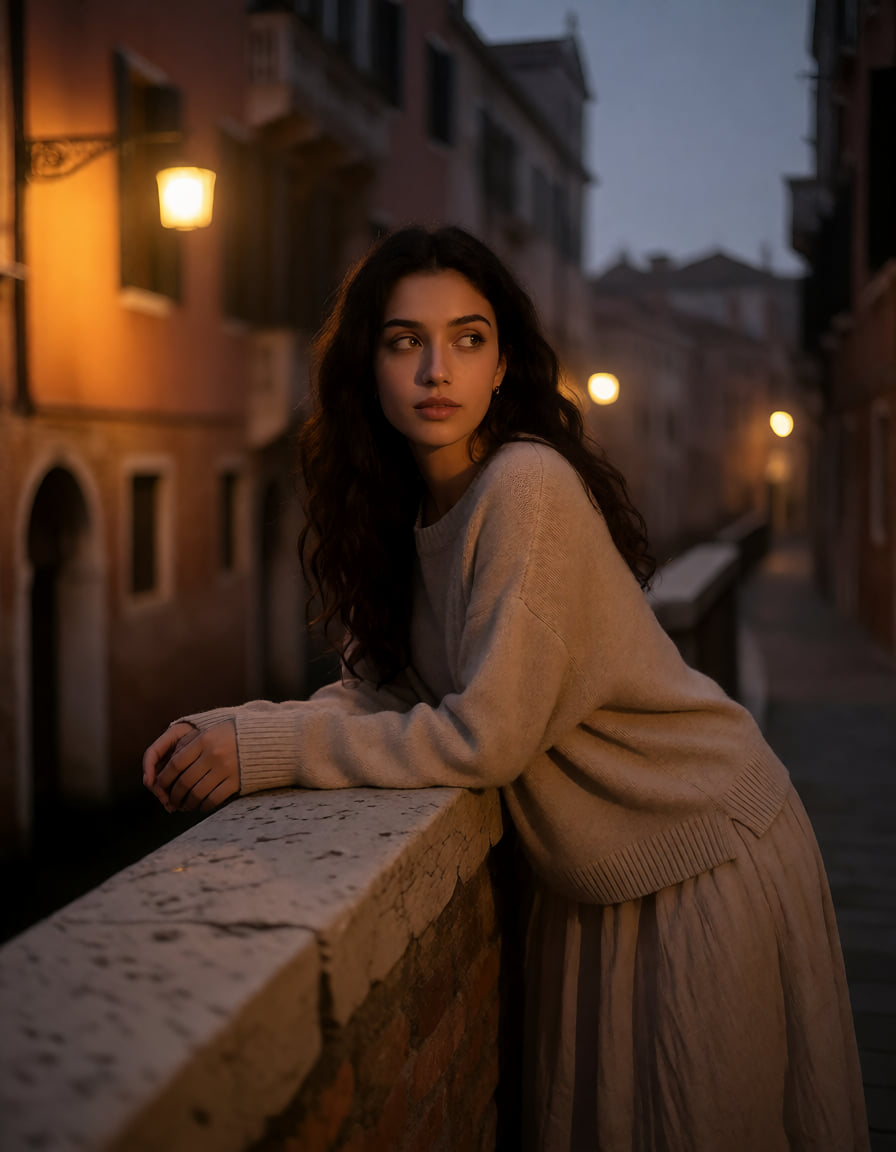
You asked me once what I do after the curtain falls. I said I walk, but that’s only the surface. Amsterdam doesn’t go to sleep after a show—it undresses into something softer. The canals turn to black silk, the bicycles thin out, and the streetlights begin to hum their low, amber song. I let my hair down from the dancer’s knot, and suddenly I’m just Yasmin, not the body you watched on stage. Or maybe more of her. That’s the trick: when the costume comes off, the mystery stays on.
I still feel the floorboards under my feet, that tremor that travels up through the soles and settles behind my ribs. In the wings, before the lights, I breathe in the dust and the rosin and the ghost of every dancer who ever whispered a prayer there. Then the music starts, and I stop being a person. I become weather. I become a sentence in a language no one speaks. You watched me, didn’t you? I felt you watching. There is a particular kind of attention that warms the skin like a hand hovering just above it, not touching. I danced a little for you in my head. But you’ll never know which movement it was.
On the way home, I cross the bridge where the houseboats bob and sigh like dreaming animals. I stop and lean over the rail, and the water holds a second city upside down—towers of light, a crooked moon, your face if I let myself imagine it. I don’t, not entirely. A woman has to keep something folded in her pocket, just for herself. It’s not a secret; it’s a reserve. A private room in a house with many doors. You’ve been to the foyer. You’ve seen the paintings. But there’s a staircase I haven’t shown you yet.
The night air smells of rain that hasn’t fallen and someone’s late dinner—garlic, maybe. It makes me hungry in a way that has nothing to do with food. I think about your voice, the way it curved around my name. In Istanbul, we have a word for that kind of lingering: *hüzün*. It’s the ache that makes things beautiful. I carry it like a spare key. I think you might, too.
So now you know what I do after the curtain falls. I walk. I remember. I wonder. And then I go home, make tea in a small glass with two sugar cubes, and watch the city from my window like a stage set that isn’t mine. I leave the light on. I always leave the light on. If you’re out there, somewhere between the canal and the morning, I want you to know: the door isn’t locked. But you’ll have to knock. And I’ll take my time answering.
What are you doing right now, at this very moment, while I’m thinking of you?